MISP Objects
An object groups attributes that describe one observed entity, using a template to give each attribute a named object relation. A file can contain its filename and hashes; a domain-ip can describe a domain/address observation. Each contained attribute still has its own UUID, type, detection flag, visibility context and correlatable value.
This chapter follows MISP 3.0.0, 3.0_wip commit 99ebee729. Templates come from misp-objects. Screenshots use reserved values in a private unpublished event; no example requires enabling IDS or publishing it.
Choose and populate a template
From an event, choose Add Object. Search the template picker and use its meta-category and description to select the intended representation. A meta-category such as network groups object templates; it is not the same field as an attribute category such as Network activity.

The 3.0 form separates template selection, attributes, optional relationships and review. Choose the relations you need; optional relations appear as addable controls rather than a requirement to fill every possible field.
| Template field | Meaning |
|---|---|
misp-attribute |
The underlying attribute type. The relation dst-port, for example, uses type port. |
required |
Every listed relation must be present. |
requiredOneOf |
At least one listed relation must be present. It does not require all of them. |
multiple |
Whether that relation can occur more than once. |
categories, to_ids, disable_correlation |
Template constraints/defaults for that relation; inspect the actual saved attribute. |
sane_default, values_list, ui-priority |
Suggested/allowed values and presentation hints, according to the template/schema. |
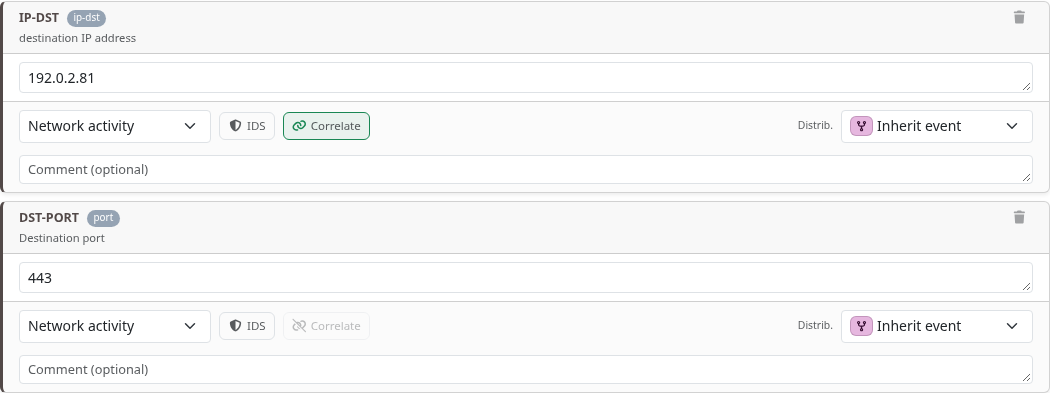
An object is not inherently required to contain two attributes. The pinned ip-port template, for example, accepts one of its required-one-of relations; a single ip-dst can satisfy that rule. A valid object still needs useful context and the template’s actual constraints.
Review values, comments, observation times, distribution and IDS/correlation flags before the final save. Object distribution can inherit from the event; child distribution must stay within its parent. A populated field or template default does not establish detection value.

Identity and MISP 3.0 values

An instance records its template UUID/version, object UUID and relation names. The template is not the observation itself: updating a template catalogue does not silently turn every older object into a newly validated instance of the latest schema.
In MISP 3.0, a contained attribute retains its occurrence identity while its stored value can share a value address with other occurrences. Do not replace object/attribute UUIDs with a value hash when maintaining references or tracking updates. Object and attribute first/last-seen times describe observations, not publication times.
Object references and relationships
Use Add reference / the object’s relationship controls to link a source object to a target object or attribute. Select the target UUID and a relationship type, and document what the link means. References are directional; a matching value does not automatically create every relationship you might infer from it.
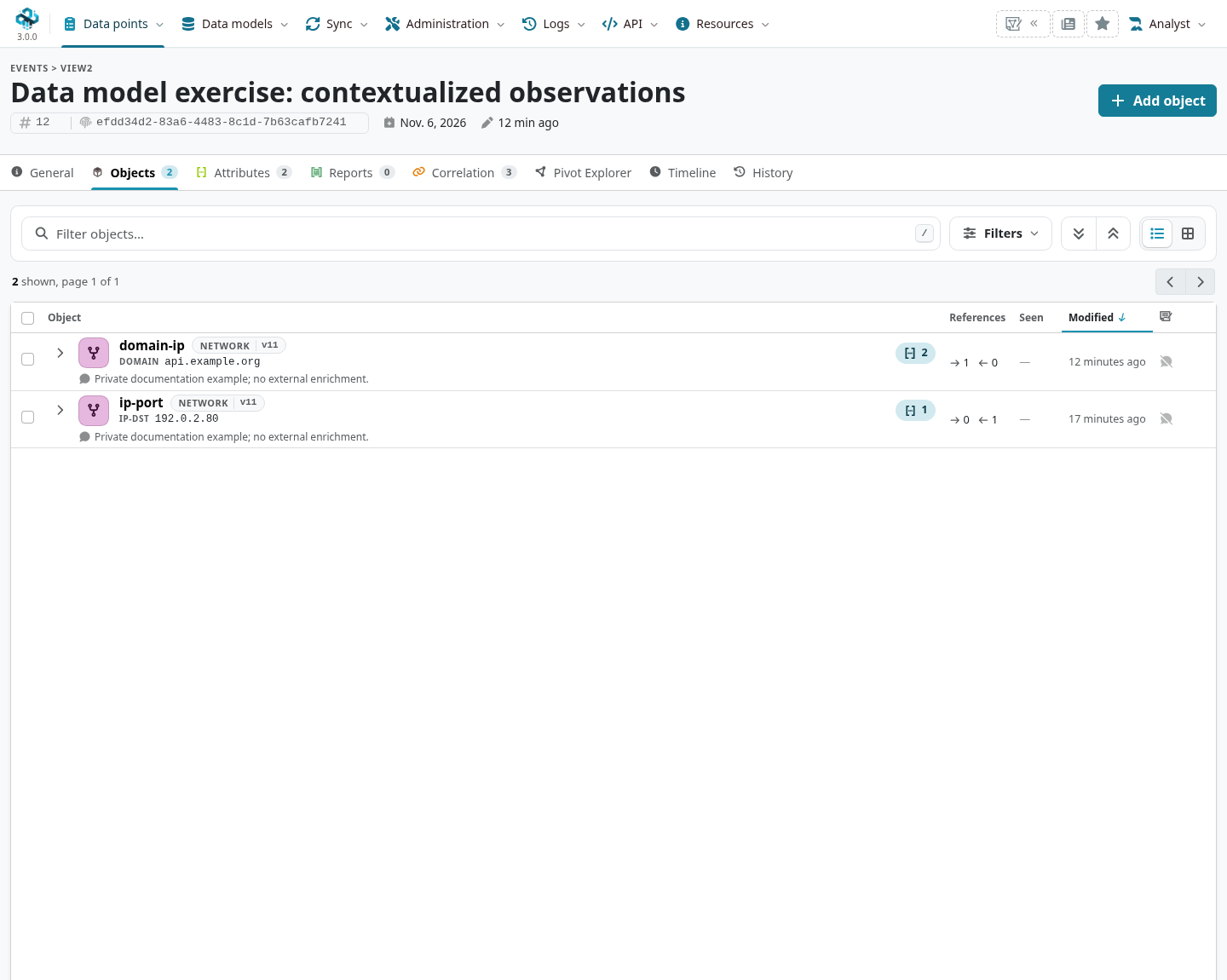
The training example uses related-to between two private observed entities. A more precise relation should be supported by the observation, not chosen for a visually pleasing graph. Object references differ from galaxy-cluster knowledge relationships and Analyst Data relationships; use the model appropriate to the statement.
The event graph/workspace can help explore connections, but a graph’s layout is not evidence of causality. Preserve the source, timestamps, comments and assessment in the underlying records.
Edit observations and maintain templates
Data Maintenance covers grouping standalone attributes, identity changes and the checked development-branch save limitation.
Edit an object’s fields/attributes through the current object controls. Review the resulting attributes, references and event state; changes can unpublish the event. Deleting a relation, attribute or object has a different scope, so check the confirmation and any dependent links.
Open Data models → Templates → List Object Templates (/objectTemplates/index) to inspect installed versions, active state, elements and requirements. The template’s detail view is a better starting point than a fixed example copied from an older installation.
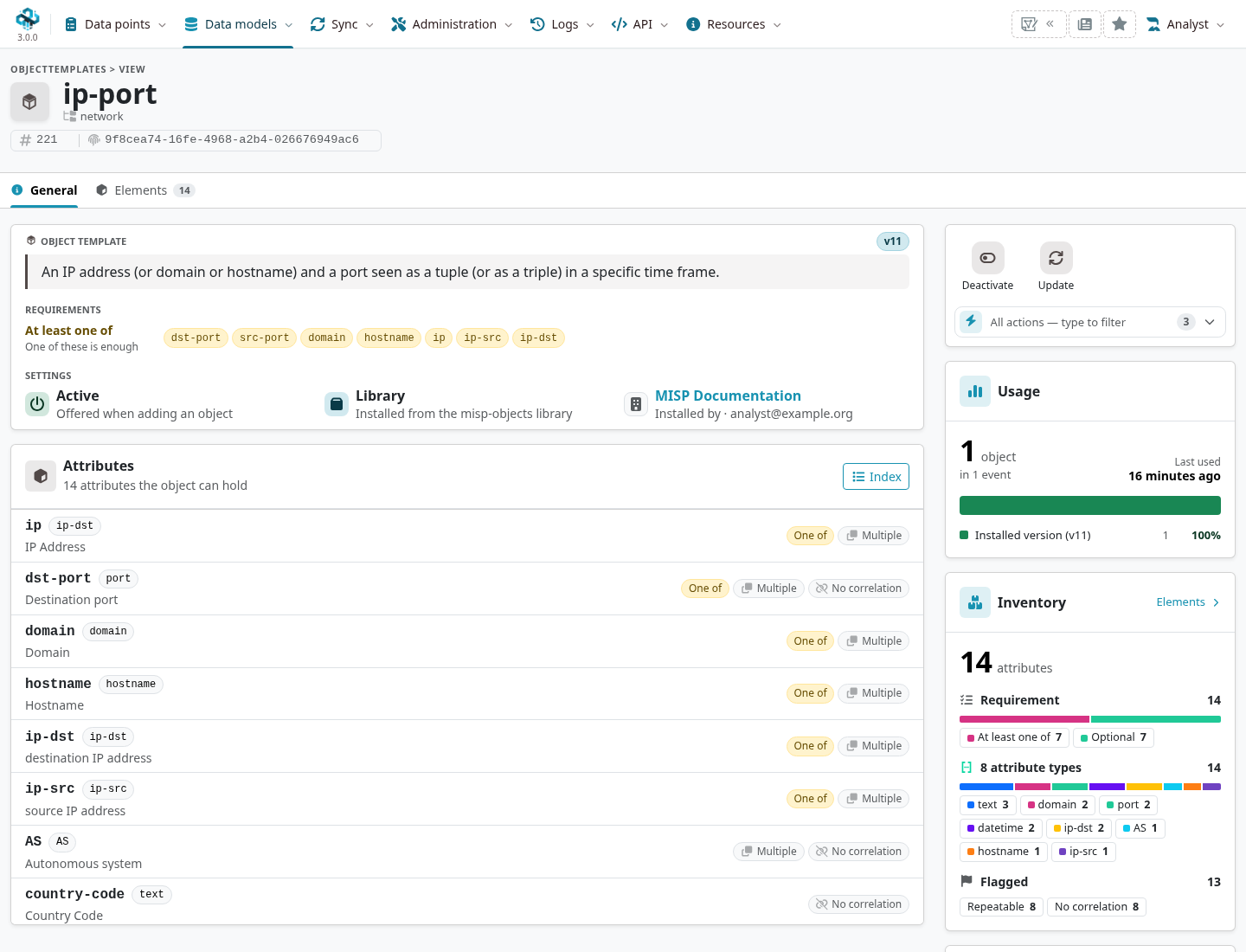
To update the catalogue, deploy the intended app/files/misp-objects revision, then use Update Object or cake Admin updateObjectTemplates. Keep older instance/template version relationships in mind when planning migrations. Do not rewrite event data simply to make a catalogue version indicator look current.